If you operate a commercial greenhouse across the EU—tomato, berry, leafy green, cut flower or medicinal crop—Fit-for-55 legislation reshapes your supplemental lighting rules starting this year, with hard mandatory deadlines and huge financial penalties for non-compliance.
Running an EU commercial greenhouse? Fit-for-55 rolled out strict new lighting rules in 2026 with fines for non-compliance.
This EU climate plan slashes carbon emissions by 55% by 2030, yet old HPS lamps eat over 40% of your electricity cost. All EU countries now enforce updated EPBD and lighting ecodesign laws, bringing three key changes:
- Phased ban on new or retrofitted HPS lights
- Mandatory minimum efficiency standards for grow lights
- Exclusive EU, regional and utility subsidies for high-performance LED upgrades
This plain-language guide covers all 2026 compliance rules and a full subsidy application process. You can cut LED retrofit costs by 15–65% on average based on your location—avoid penalties and claim rebates before funding runs dry.
Part 1: Fit-for-55 Mandatory Greenhouse Lighting Requirements Effective 2026
1.1 HPS Phase-out Deadlines (Non-Negotiable Compliance Deadlines)
The EU’s ErP ecodesign and lighting energy rules tie directly into Fit-for-55 carbon reduction targets, with staged bans on inefficient mercury-containing HPS hardware:
- End 2025: All mercury-heavy 250W / 400W HPS lamps banned from EU retail and wholesale supply chains. Stockpiled spare parts are already scarce, and replacement costs have jumped 30–50% across the Netherlands, Spain and Germany per local greenhouse industry association reports.
- Full 2026 enforcement: Agricultural officials audit lighting systems. Fines start at €1,200 per non-compliant fixture; mandatory retrofit within 6 months.
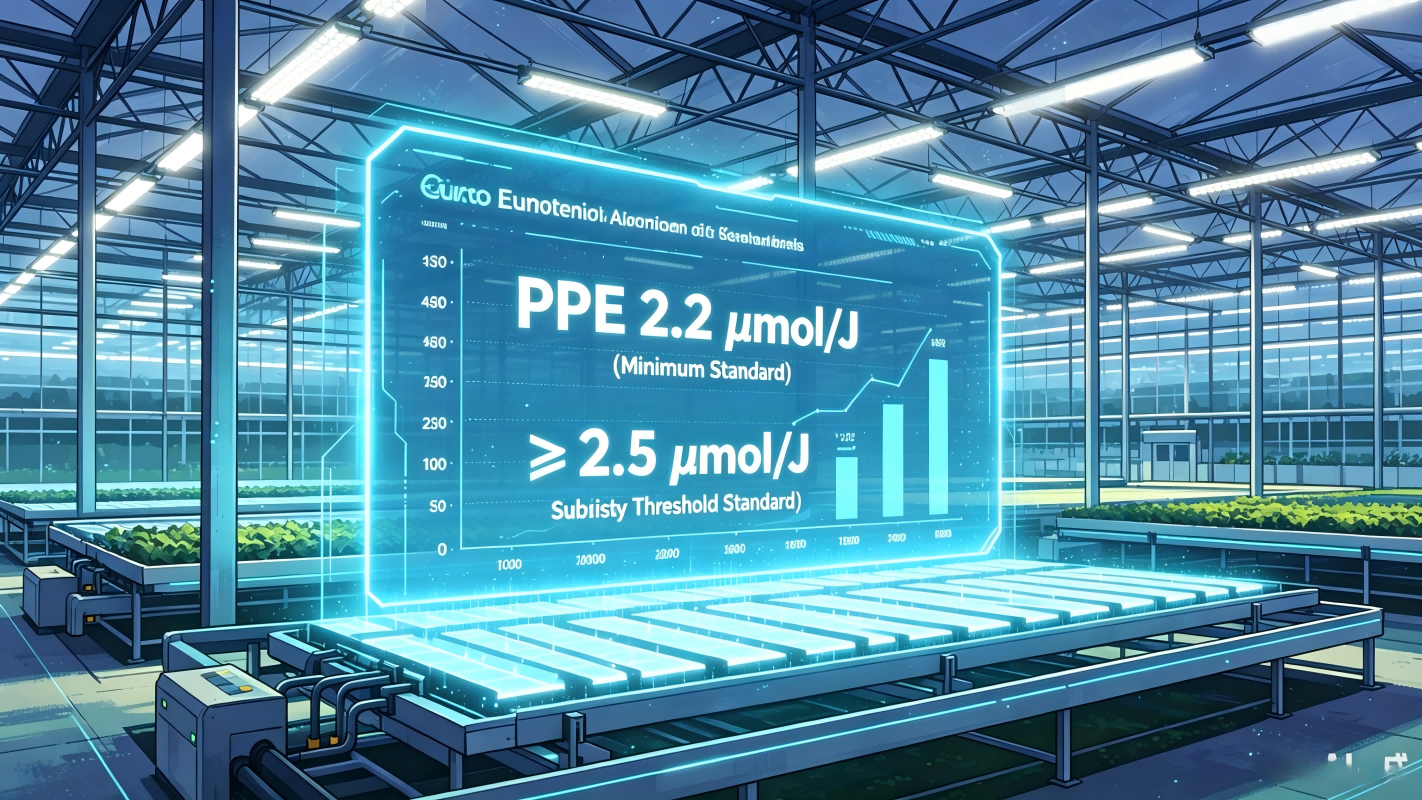
- 2028 hard cutoff:Commercial grow lights must hit minimum 2.2 μmol/J PPE; no exemptions for small greenhouses.
Key Grower Challenge: HPS waste heat used for winter heating is not exempted. Operators must adopt low-heat LEDs paired with waste heat recovery or low-carbon heating.
1.2 Mandatory LED Performance Standards for EU Greenhouses (2026 Benchmarks)
-
PPE Requirement: Legal minimum 2.2 μmol/J; ≥2.5 μmol/J required for maximum EU subsidies.
-
Energy Label: Updated A–G rating replaces old A+++. Only Class A/B LEDs qualify for full rebates; Class C gets reduced support; D–G receives zero public funding.
-
EPREL Registration: All LED models must be registered in EU EPREL database with fixture QR codes. Unregistered units lose subsidy eligibility.
-
Smart Control Rule (Over 1,000 m² Greenhouses): IoT LED systems with adjustable spectrum/dimming are compulsory. Static single-spectrum lights fail legal standards and grant access.
-
Safety & IP Ratings: Base LEDs IP44 minimum; under-canopy interlighting IP66; RG0 UV hazard certification per IEC 62471-7.
1.3 5-Year Mandatory Energy Record-Keeping Starting 2026
Required documents:
pre-retrofit energy audit, monthly kWh logs, carbon reduction calculations, fixture compliance certificates, EPREL numbers and vendor invoices.
Sites under 500 m² follow simplified reporting; incomplete records invalidate all rebate applications.
Part 2: All Subsidy Streams Available for EU Greenhouse LED Retrofits
Growers can stack three Fit-for-55 funding sources: EU core grants, regional top-ups and utility rebates, with variable rates per country.
1. EU Central Grants
- NextGenerationEU (PRTR)
Main subsidy for Spain, France, Italy, Portugal: 40–65% cost coverage for smart A/B LED retrofits; extra 15% bonus for rural farms. Static low-efficiency lights are excluded.
- Modernisation Fund
For low-income Eastern/Southern EU nations, calculated by annual kWh and CO₂ savings, ideal for large glass greenhouse parks.
- Agriculture Climate Innovation Fund
Up to 35% reimbursement for custom spectrum and interlighting for berries, medicinal crops and premium flowers.Standard payout metrics: €0.10 per annually saved kWh, or ~€500 per ton of annual CO₂ cut.
2. National Regional Top-Ups
Each EU member state adds local premium funding stacked on top of EU base grants, with variable rebate percentages:
- Netherlands: Extra 22% rebate for HPS-to-LED glasshouse retrofits; priority for tomato/cucumber growers
- Germany:BAFA agri energy grants; +20% extra for IoT lighting controls
- Belgium (Flanders): Tiered bonuses; small family farms may double base EU rebates
- Spain: IDAE PREE 5000, first-come-first-served annual funding with Q1 application window
3. Local Utility Incentives
- Fixed cash rebate: €80–€220 per eligible Class A LED fixture
- Zero-down on-bill financing: Repay costs via electricity savings over 3–7 years at low/0% interest
- Per-kWh rebate: €0.08–€0.16 for every kWh reduced yearly after LED upgrades
Part 3: 4-Step Subsidy Application Process (Grower-Friendly)
Most rejected applications fail due to skipped pre-approval steps or non-compliant fixture selection. Follow this exact sequence to avoid delays and full claim denial. General processing timelines below reflect regional average waiting periods and are not fixed legal deadlines:
Step 1: Pre-Application Compliance Check (Before LED Purchase)
- Calculate greenhouse area, existing HPS quantities, wattage and annual power consumption.
- Verify LED specs: PPE ≥2.5 μmol/J, EPREL registration, Class A/B label, required IP and RG0 certification.
- Confirm suppliers provide full EU compliance documents.
- Check remaining 2026 regional funding pools in Q1; most budgets run out by August.
Step 2: Secure Mandatory Pre-Approval
All grants require official pre-approval before fixture purchase. Post-purchase claims get automatically rejected.
Submit forms via national agricultural energy portals (IDAE/BAFA/RVO) with site layouts, energy audits, LED datasheets and projected savings. Allow 2–6 weeks for official approval before ordering equipment.
Step 3: Certified Installation & Full Documentation Storage
After pre-approval clears:
1. Execute fixture install by EU-certified electrical contractors (unlicensed labor voids rebates across nearly all EU funding programs).
Retain every document for submission:
- Full vendor invoices (separate line items for fixtures, wiring, smart controllers, labor)
- EPREL QR code labels photographed on each installed luminaire
- Post-install third-party energy audit report proving measured power savings
- Old HPS disposal receipts (EU WEEE circular economy rules require certified e-waste recycling)
- IoT lighting system connection verification logs for smart control mandates
2. Keep all physical and digital records for 5 years post-payout for compliance audits.
Step 4: Final Claim Submission & Payout
Upload all pre-approval, installation and audit PDFs to regional funding portals, and complete carbon saving declarations. File utility rebates separately through power company portals in parallel.
- Small farms (<100 fixtures): 4–8 week review, lump-sum payment
- Large greenhouse parks: 8–16 week technical audit; partial advance payments available on request
Part 4: Top Application Mistakes That Forfeit Rebates
We compiled the top errors seen in 2025–2026 EU subsidy audits to help you avoid costly delays:
- Buying unregistered low-PPE LEDs without prior pre-approval
- Missing mandatory third-party pre and post energy audits
- Lack of certified HPS e-waste disposal documentation
- Missing regional funding deadlines; unused funds do not roll over to the next year
- Installing non-smart static lights in greenhouses over 1,000 m² (EPBD violation)
- Mixing compliant Class A LEDs with unqualified units in one project (full or partial claim rejection)
Part 5: How Qualified LED Retrofits Solve Core Grower Pain Points
- Sharp electricity cuts: Class A LEDs reduce lighting power use by 45–70% vs HPS. Combined rebates deliver average ROI of 12–18 months. Tunable spectrum boosts crop yields by 10–15%.
- Lower climate control costs: Less waste heat reduces ventilation/cooling loads and suppresses mould, mildew and pests.
- Stable supply & less maintenance: HPS production ends late 2025 with scarce, expensive spare parts. Modular LEDs offer
Conclusion: Quick 2026 Grower Action Checklist
- Complete full HPS energy audit before Q3 2026
- Source only EPREL-registered Class A/B LEDs with PPE ≥2.5 μmol/J and full compliance paperwork
- Submit pre-approval for all subsidies before ordering fixtures
- Arrange certified electrical installation and archive all audit/invoice records
- File full subsidy claims immediately after installation before annual funding pools deplete
Contact our B2B horticulture lighting specialists for free custom retrofit quotes and subsidy eligibility assessments.
Email: info@sunritek.com | Tel: +86-755-83168270 | Website:
www.sunritek.com

